
May 18, 2026 | Source: Friends of Givat Haviva
Givat Haviva, University of Haifa Conference on Hebrew Education in Arab Society
Givat Haviva–University of Haifa Conference on Hebrew Education
By Enno Ebersbach
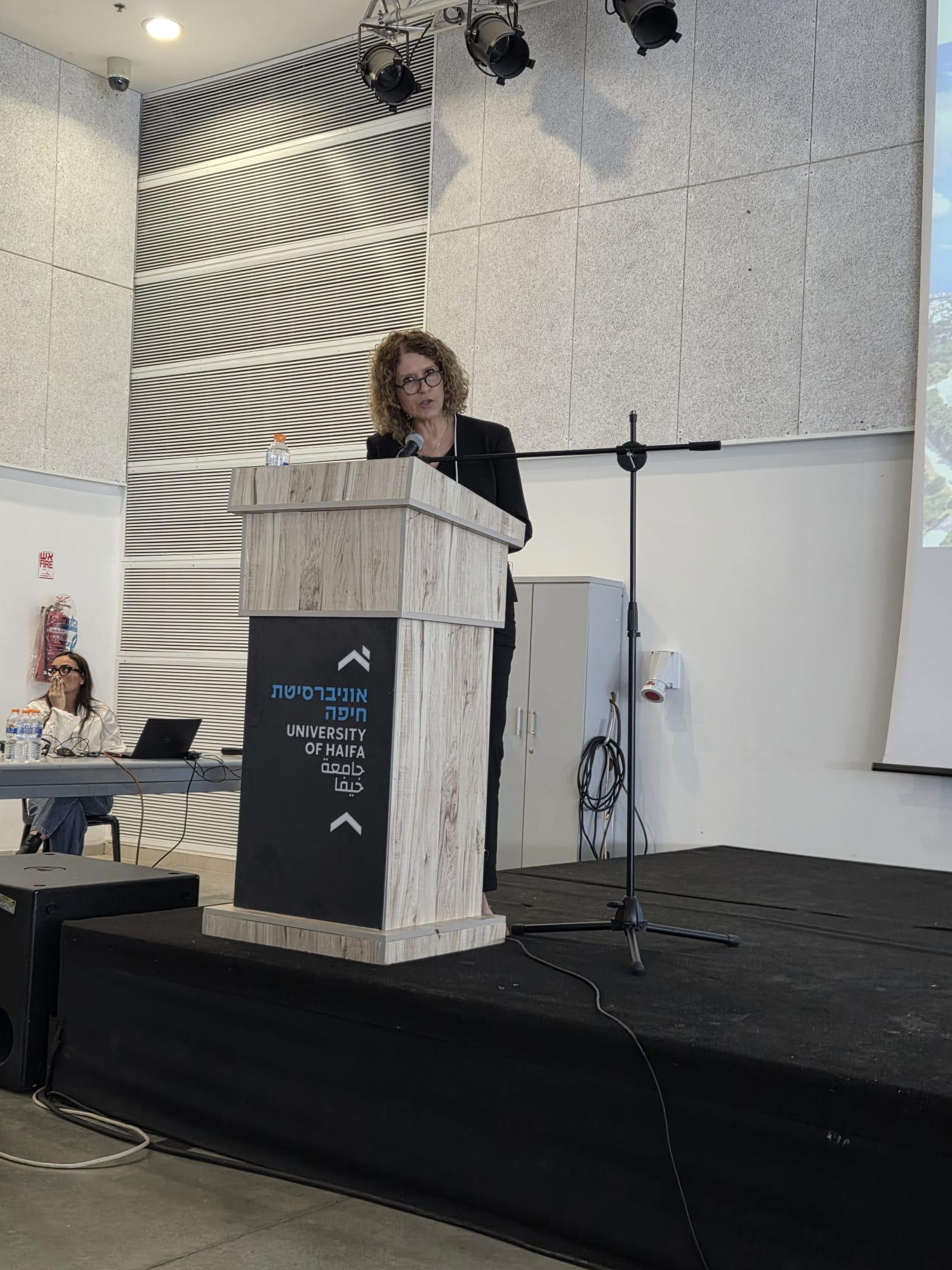
Although Hebrew fluency is essential for success in Israel’s economy, academia, and public life, speaking Hebrew remains a challenge for many Arab citizens of Israel, who often have limited exposure to the language in daily life. To address this challenge educators from across the country gathered at the University of Haifa on May 6 for a conference on the future of Hebrew-language education in Arab schools. Co-organized by Givat Haviva, the “Hebrew as a Key” conference focused on improving Hebrew instruction as a way to expand opportunities for Arab citizens and strengthen their integration in Israeli society.
Prof. Mouna Maroun, the University of Haifa Rector, opened the conference by reflecting on her own experience. She recalled that despite studying Hebrew literature in school, she struggled to speak Hebrew when she entered university. “I still remember asking a classmate for chewing gum. It was my first full sentence in Hebrew at university,” she said.
Maroun, the first Arab Israeli woman serving as rector, warned that declining Hebrew proficiency among Arab youth, largely due to changing media habits, deepens separation between Jewish and Arab students on campus and weakens Arab students’ confidence in academic settings. Universities, she stressed, have a responsibility to help bridge that gap.
Ola Najami-Yousef, director of the Jewish-Arab Center for Peace at Givat Haviva, delivered a personal and emotional address. Emphasizing that “with words we build bridges, and with language we create the future,” she framed Hebrew as a path toward opportunity, belonging, and connection between communities.
Najami-Yousef spoke candidly about her own experience with learning the language. “There were mistakes, moments of insecurity, and moments when I wanted to give up,” she recalled. Still, she described how each new word and sentence gradually became “another door that opened.” Today, she said, Hebrew represents far more than communication: “It is a key to integration, to studies, to employment, and, most importantly, to a sense of belonging.”
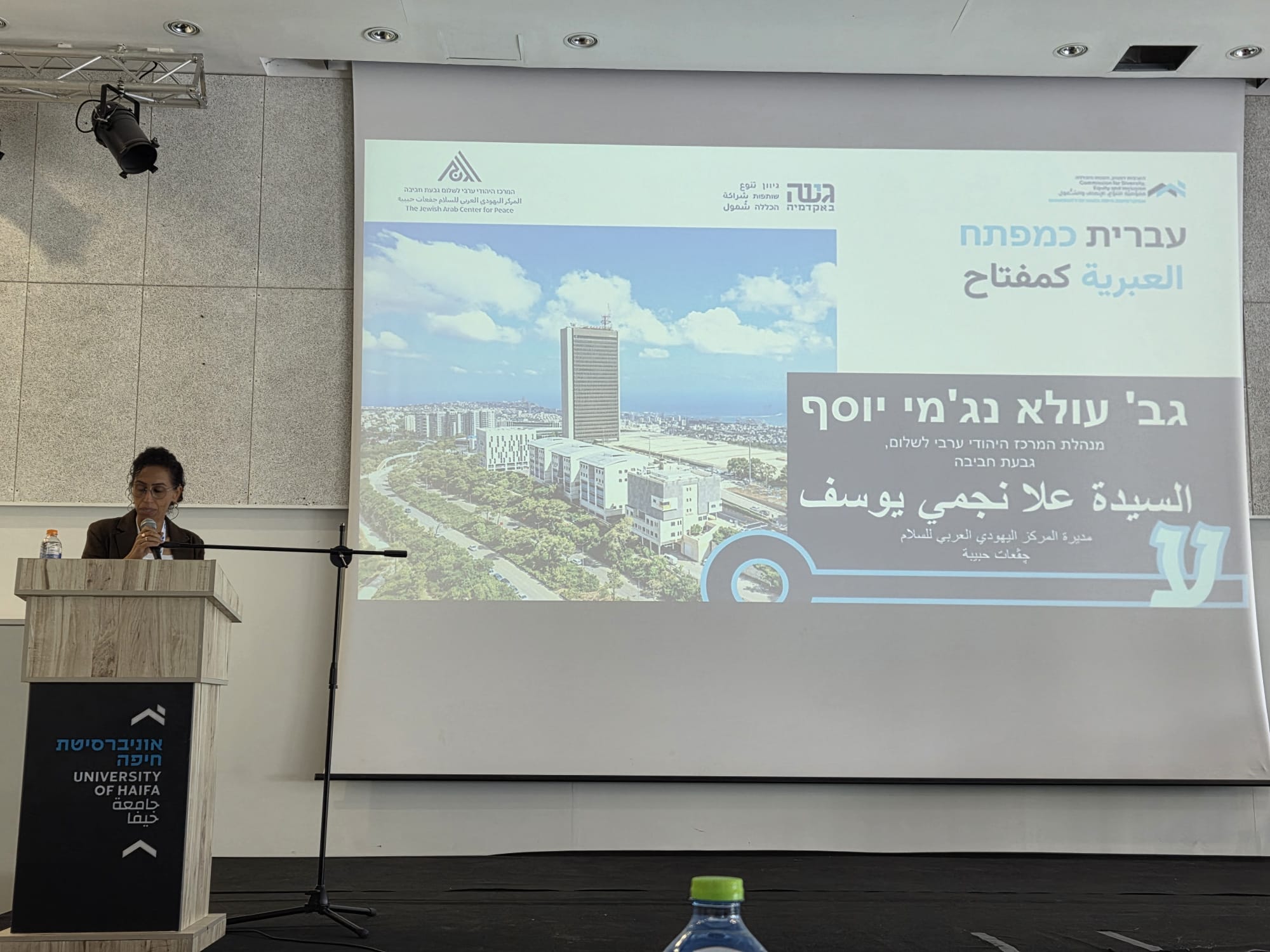
At the same time, Najami-Yousef stressed that strengthening Hebrew knowledge should never come at the expense of Arabic identity and culture. In her view, the two languages complement rather than compete with one another. She emphasized the importance of Givat Haviva’s “Shared Language” program, which brings Jewish-Israeli Hebrew teachers into Arab schools. The program does more than teaching grammar and vocabulary. It also creates human connections and greater understanding between Jewish and Arab communities.
A new study by the University of Haifa and NAS Research & Consulting on the challenges Arab students face in Israeli academia was presented. The findings revealed significant regional and gender disparities in Hebrew proficiency. Notably, despite achieving higher grades in high school, young Arab women were found to be less fluent in spoken Hebrew than their male peers. The study also showed that Arab-Palestinians living in East Jerusalem have comparatively lower Hebrew proficiency than those living in mixed cities such as Haifa. Researchers emphasized the need for more practical, conversation-based Hebrew instruction in schools to better prepare Arab youths for universities and workplaces. The study also recommends that universities continue to strengthen students' Hebrew knowledge during their studies.
Two Arab students spoke about their experiences entering Hebrew-speaking academic environments. One student described overcoming the fear of imperfection: “I realized I couldn’t wait until my Hebrew was perfect. I simply had to start speaking.”
The conference also featured several panels bringing together educators, researchers, government officials, and technology experts to discuss practical ways of improving Hebrew instruction and strengthening integration between Jewish and Arab students.
One panel focused on the experiences of teachers and university staff working directly with Arab students. Participants described how many students arrive at universities with strong knowledge of written Hebrew and grammar, yet struggle with spoken language and self-confidence in classroom discussions. Several speakers stressed the need to move away from purely formal instruction toward more practical, conversation-based learning that prepares students for everyday academic and professional situations.
Another panel explored the role of technology and digital tools in language education. Representatives of the educational platform Eurekaworld presented a metaverse-based learning game designed to improve students’ language abilities through interactive and engaging methods. The discussion also addressed the growing role of artificial intelligence in modern language instruction and how digital tools can help create more immersive and accessible learning environments for students who have limited exposure to Hebrew outside the classroom.
The conference concluded with a panel of representatives from several government ministries discussing the role of state institutions in promoting Hebrew-language education in Arab society. Speakers highlighted the importance of cooperation between ministries, universities, and civil society organizations. Yonatan Paz, from the Authority for Economic Development of Arab Society, emphasized the contribution of organizations such as Givat Haviva, arguing that meaningful change cannot come only from top-down government policy, but also requires local initiatives that understand the specific realities and challenges facing different communities.
Closing the event, Arin Salameh-Kudsi, Head of the Commission for Diversity, Equity and Inclusion at Haifa University, returned to one of the conference’s central messages: language is not only a tool for academic, professional and economic advancement. It is a means of building trust, connection, and a shared future between communities.