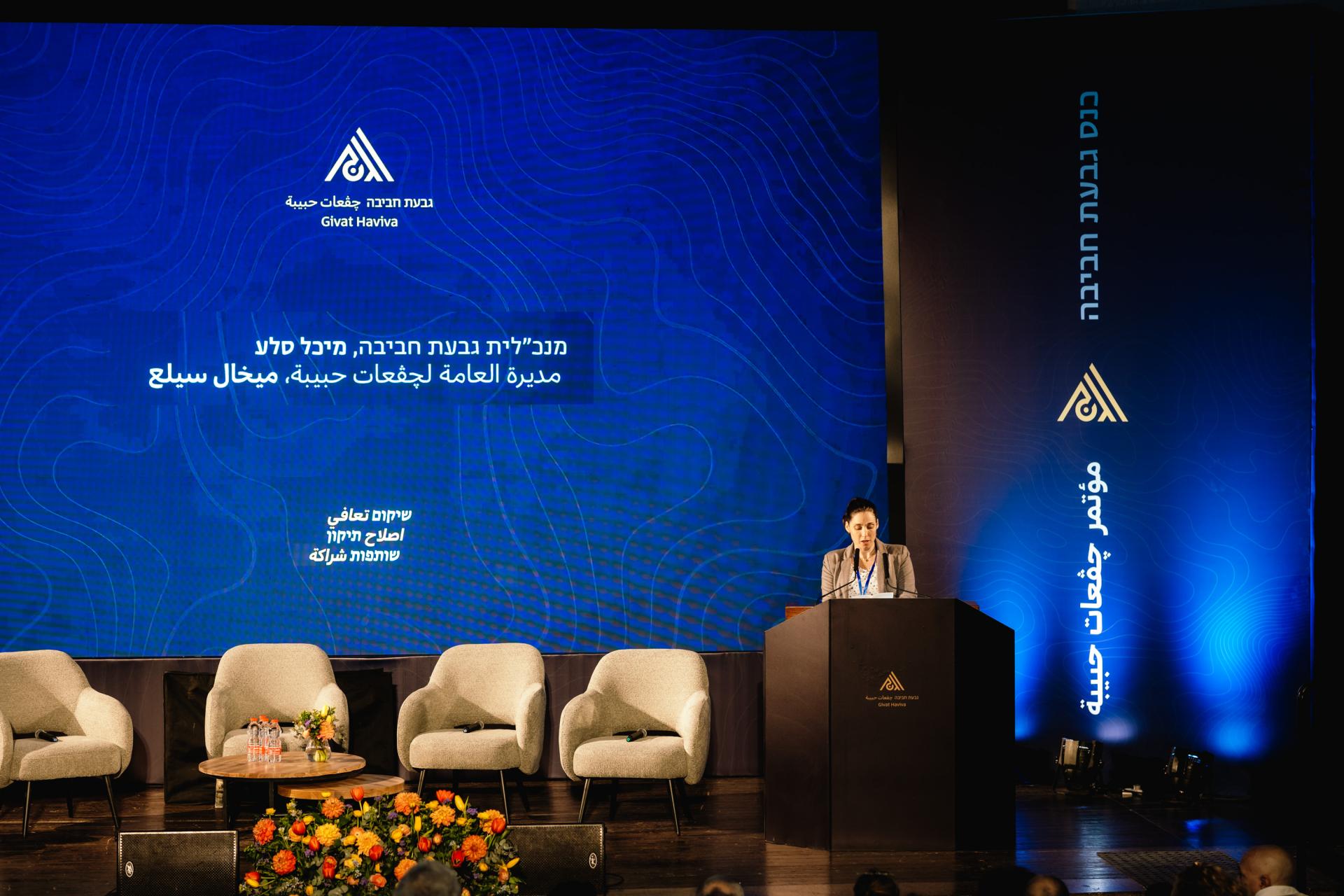
Givat Haviva CEO Michal Sella Opens Shared Society Conference
January 6, 2026
Michal Sella, Givat Haviva CEO, Addresses Shared Society Conference
Welcome to Givat Haviva and thank you all for joining us today.
This is the third year that we are holding this conference amid a reality of extreme uncertainty. As human beings, it is very difficult to contain the flood of dramatic and historic events unfolding in our country and around the world in recent years.
Since the last Givat Haviva Conference, the war in Gaza has ended and all the living hostages have returned, while we are still awaiting the return of the final hostage, Ran Gvili.
And yet, contrary to what we had hoped, it is still hard to breathe. The easing of the security situation and the end of the war have not brought a sense of relief. We are more divided, more hateful, and more fearful of one another than ever. This government continues to incite us against each other. Arab society is being crushed under a wave of crime and violence the likes of which we have never seen, while the responsible minister and the police do almost nothing.
This year saw a record number of educated Israelis — Jews and Arabs — leaders who drive our society and contribute to it, leave Israel because they chose not to live here, not to raise children here. Israelis who are the future of Israel’s economy, society, and culture have evacuated their families from this country.
Because the truth is that, from time to time, despair grips even us.
But in the face of that despair, we choose to look forward and identify an encouraging crossroads. This will be an election year. We will all be given the opportunity to vote for the direction in which we want to lead the country: toward international isolation, hatred, racism, crime, and unrestrained violence as offered by Ben Gvir and Smotrich? Or toward a slow healing process that offers normalcy and fair, democratic basic values?
The truth is that most Israelis, Jews and Arabs alike, choose the second option. Now the only question is how more than half the public — those who choose normal life — can manage to work more or less together in order to defeat a minority that sanctifies crime, hatred, and violence.
The Givat Haviva Partnership Index, published today and to be presented in greater detail later in the conference, paints a complex but important picture.
In Arab society, we see a clear trend of growing willingness for full political participation. Arab citizens of Israel express a desire to be part of government — not merely to influence from the margins, but to sit around the decision-making table.
In Jewish society — unsurprisingly — the right shows almost total opposition to political partnership with Arab parties, while the left shows almost total support.
But it is very important today to shine a light on the center, where we see a divided, hesitant public. Some support full coalition partnership with Arab parties; some struggle to imagine this but are willing to accept external support; and many simply say: we don’t know. And this “we don’t know” is not a weakness — it is a space for action, a space for courageous political leadership that does not exist today.
It must be remembered that the absurdity is that Israel’s centrist leaders, who currently reject the possibility of political partnership, were only able to sit in the “government of change” thanks to that very partnership. But today they are too afraid to defy Netanyahu — their rival.
Here is proof for them that their voters are asking for leadership. They are uncertain; they need direction from their leaders on how to save this country and this society. And the only way is cooperation among the majority of the Israeli public that wants change toward a normal, democratic direction. Yes — even if part of it is Jewish and part of it is Arab. It is still a majority of Israel’s citizens.
Our data also exposes troubling generational gaps. Young Jewish people, who grew up in a reality of almost total separation and who have not known any significant leadership outside Netanyahu’s governments, struggle to imagine Jewish-Arab political partnership — unlike their parents. They are comfortable with racist and violent rhetoric because this is what they have heard from ministers and important people in suits since they were children. This is a severe warning light for the education system and for the state as a whole.
A country in which the chair of the Knesset Education Committee, Zvi Sukkot, is a person who breaks into IDF bases, shows contempt for the law, is under Shabak investigation, and is a criminal, cannot take responsibility for the basic education of its children. Today we live in a country where extreme religious education systems that actively promote racism receive enormous budgets and institutional support compared to state secular Jewish or Arab education. If your child is a non-religious Jewish child or an Arab child studying in the state education system, they are discriminated against in every sense by the education system that you are its primary funders.
So, who, after all, is protecting the children and youth who are meant to operate a democratic state in the future? Only educators. Principals and teachers whom we meet every day here at Givat Haviva. The last line of defense protecting most children and youth in Israel are frontline educators.
We meet students, teachers, parents, and local leaders who ask to meet, to talk, to understand, and to cooperate — even when the pain is great. This is not an escape from reality; it is direct engagement with it. This is the importance of education for a shared society.
These are educators who choose to teach the rule of law, equality, and democracy even when the system signals to them — and at times even threatens them — not to do so. They are true heroes. If you encounter them, if your children are fortunate enough to learn from such educators, thank them. They are among us in the hundreds and thousands, educating — often for insulting salaries, in a profession that is frequently disparaged — the future generation of Israel.
This conference is taking place at a critical moment, a volatile moment, a moment in which the ground could slip from beneath our feet. And therefore, it is also a moment when responsibility passes to us: to civil society, to local leadership, to educators — to demand from our politicians and leaders, to struggle, and to propose an alternative.
A shared society is not a luxury. It is a condition for security, for democracy, and for a future in this land. Without equality, without fair law enforcement, and without civic and political partnership — there will be no future here. Leaders who say they want change but refuse to acknowledge this mathematical fact are failing in their duty and are condemning all of us, and the state itself, to a loss from which we may not recover. They have no right to do this to us.
I thank our partners, the dedicated Givat Haviva staff, the speakers, and you — for choosing to come and say: we do not give up. This is the time for repair, recovery, and partnership.
I wish us all a courageous and interesting conference — one that gives us the strength to continue believing and to educate our children that it is possible for things to be good here.