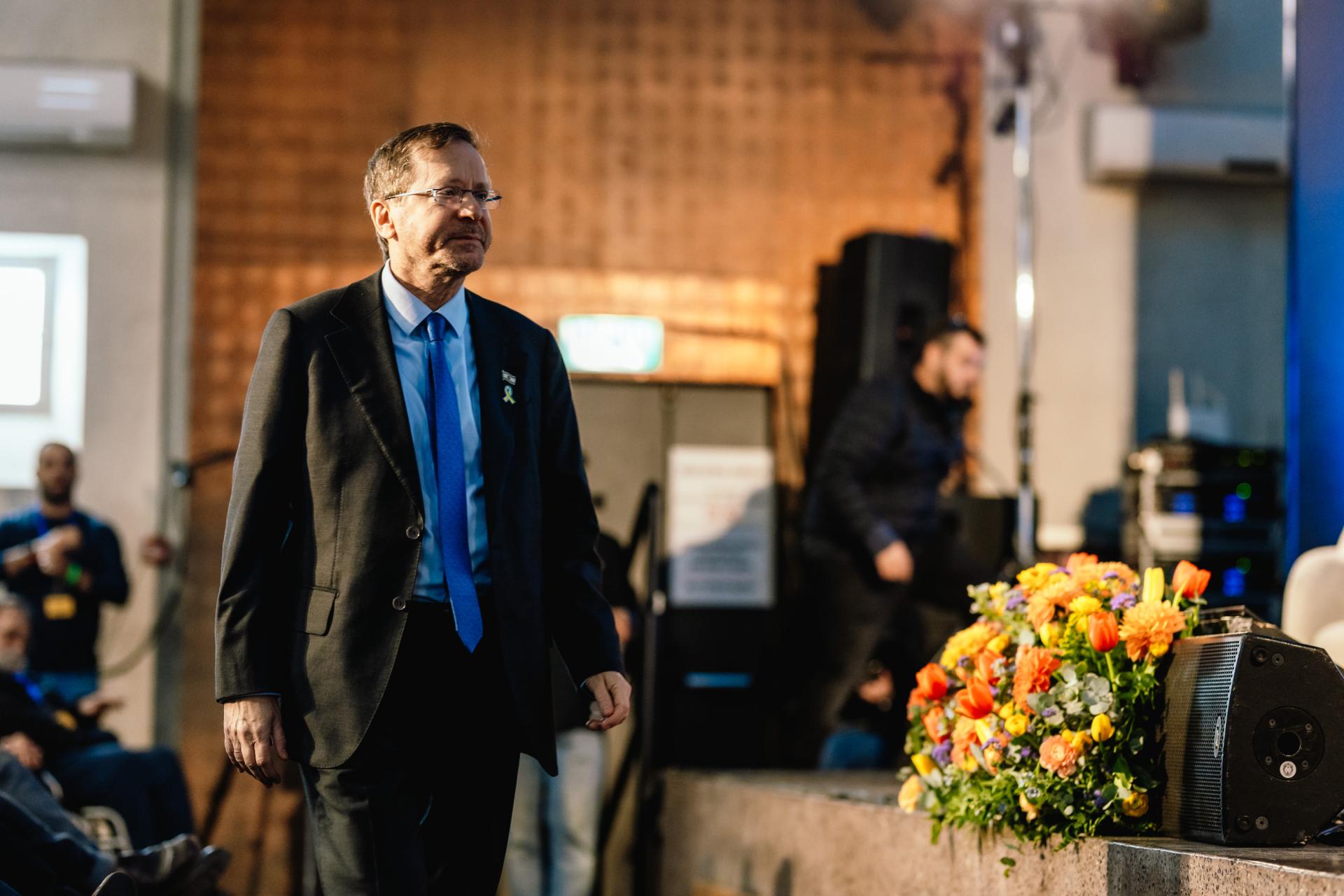
President Herzog Praises Givat Haviva in Keynote Address
January 6, 2026
Israel President Isaac Herzog Addresses Givat Haviva Shared Society Conference
I thank you for the opportunity to speak before you today, at this important conference, which seeks to chart the path for Israeli society’s transition from the complex state of war we have known for more than two years—toward a reality of hope, healing, and recovery.
There are those who will argue that it is too early to deal with this. However, it is clear to me, and clear to all of us here—especially to the women and men of education among us—that whether we like it or not, we do not have the privilege of waiting. Besides, anyone who has spent more than a day or two in the Middle East knows how thin the line sometimes is between war and peace, between chaos and calm, between despair and hope.
With your permission, and not surprisingly, I wish to argue here today that our path from destruction to recovery, and from despair to hope, passes through one single route, and one only: partnership. Indeed, it is no coincidence that this important conference is taking place here, at the Center for a Shared Society in Givat Haviva, which for many years has proudly upheld the vision of partnership. The days of war, sadly, have been and continue to be especially fertile ground for agents of hatred, despair, and chaos.
In fact, it is no secret that the horrific massacre of October 7 sought to create precisely this chaos—to annihilate and destroy not only human beings—men and women, the elderly and innocent children—who were shot, tortured, burned, and abducted from their beds into the tunnels of terror of the despicable terrorist organization. The perpetrators also sought to destroy the very idea and belief in a reality of shared life among people of all faiths and religions in this space—within the State of Israel and beyond it.
Therefore, my sisters and brothers, against those who generate hatred and terror, against those who spread this propaganda of death and destruction, we must advance the vision of partnership as one that stands at the heart of Israeli statehood—accompanying us from the founding words of the Declaration of Independence. This is also the spirit of Givat Haviva.
I wish to emphasize: this is true for changing reality toward partnership throughout the entire Middle East—but it is no less true for internal Israeli partnership in particular, especially regarding our relationship, as a state, with Arab society in Israel. Arab citizens of Israel are an inseparable part of Israeli society and of the State of Israel—and they are deserving, as a matter of right and not of charity, of equality in the fullest sense of the word.
The gaps we see today between Jews and Arabs in Israel—first and foremost, of course, in law enforcement and personal security, but also in education, welfare, planning, infrastructure, employment opportunities, and allocation of resources—are indeed the result of decades, and it must be said honestly that they require major and even urgent correction. All the more so, it is forbidden to harm the essential multi-year plans, whose contribution to education and welfare in Arab society is truly existential.
Allow me to be simple and direct and to say what I have said again and again in recent years, especially in the past year: the issue of crime, criminality, and the loss of personal security in Arab society in Israel is a national challenge in every sense. It is a challenge that must occupy the country’s leadership day by day as a top priority. The responsibility of the communities and of Arab society itself certainly has its place—but nothing can replace the responsibility of the state. The sovereignty of the state.
Arab citizens of Israel are entitled to personal security like every citizen in Israel. Arab localities must be safe—exactly, but exactly—like every locality in Israel. The law on Arab streets is Israeli law, and it must be ensured that it is enforced not only when it concerns building violations, but across all spheres of life—and first and foremost when human lives—Jewish and Arab alike—are at stake.
Last night I once again reiterated my resolute call to uproot this horrific phenomenon from the ground up. I referred to the murder of a father and his son, residents of Tur’an who worked in Nazareth, and this was even before the murder in Kafr Qara. I reiterated and determined that this reality is not a decree of fate—it is a critical national mission that can be addressed.
To these points I wish to add: the lack of equality in Israel generates not only the national challenge I spoke about, but also a missed opportunity—on a historical scale. Arab society is perhaps the resource with the greatest potential, and at the same time the most underutilized, of the State of Israel.
Arab society in Israel is filled with a vast and inexhaustible reservoir of talent, dreams, values, abilities, energy, and vitality—into which not enough is invested, and thus they are not harnessed to the train of Israeli success and prosperity. And since we are all “one human fabric,” for better or worse, those who do not feel a sense of belonging and are not harnessed to the train of success will also not allow the engine to keep moving forward. I am troubled by the departure of very talented young people and families who have simply lost hope.
In this context, and on the national level, I wish to recall the explicit data that appeared in the “Israeli Democracy Index” that was recently submitted to me by the Israel Democracy Institute.
According to the index, the overwhelming majority of Arab citizens of Israel believe that it is desirable for Arab citizens in Israel to integrate into Israeli society and be part of it at all levels—including the most influential political and public levels. These are dramatic data in my view, pointing to the depth of the desire for partnership—at least from the grassroots, meaning from the Arab public in Israel. I hope that this sentiment will be reflected among the entire public in Israel, Arabs and Jews alike.
Partnership is our daily bread. It is not a privilege reserved for the future. Without it, neither we nor our children have a future in this place, in our shared home. This is why I thank you all for the opportunity to be here today—to bless and to strengthen your hands in your important work. I sincerely hope that this important conference will continue the precious endeavor that has been taking place at Givat Haviva for many years and will deepen the bonds of partnership between Jews and Arabs—partnership based on justice, mutual respect, trust, and hope. I thank the leadership of Givat Haviva for its many blessed initiatives in the field of partnership.
Let us all conclude with a shared prayer, first and foremost for the return of Israel’s hero, Ran Gvili, to the landscape of his homeland; I strengthen and embrace all those who protect us, and I pray and yearn for the healing of the wounded in body and soul; I wish comfort and solace for the beloved and precious bereaved families, and that we may all know better news. Thank you all—go forth and succeed.